
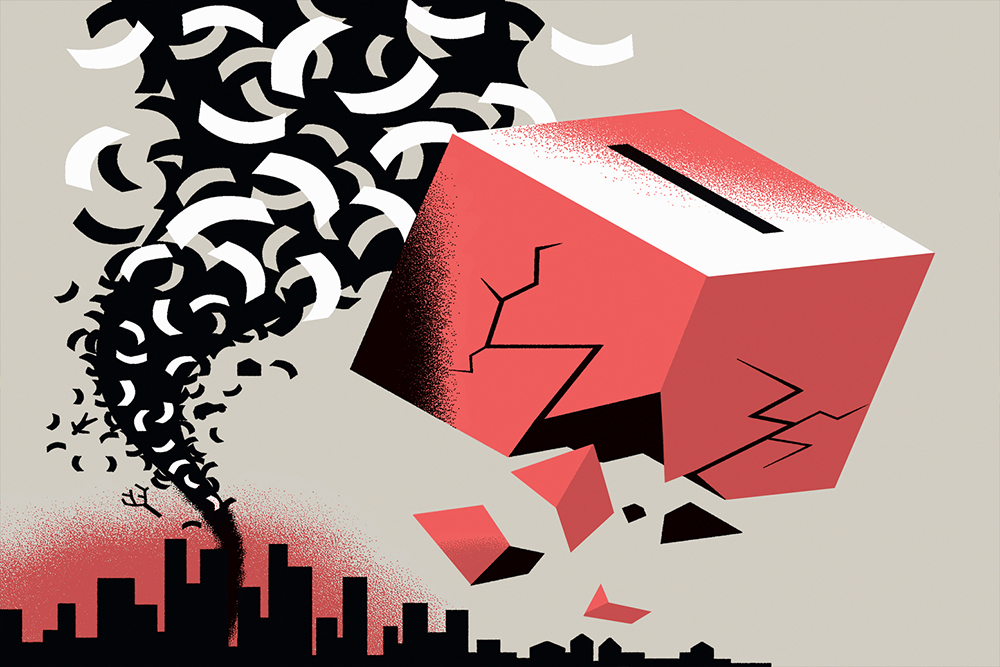
It has been decades in the making, but the fragmentation of Britain’s party system now looks like a permanent feature of the political landscape. Despite the way first past the post incentivises two-party politics, this great fragmentation was inevitable. This is no longer the society of the twentieth century. Culture, class and the desires of social groups have broken into myriad pieces; sooner or later those fractures were bound to be reflected in the body politic.
We saw in both 2019 and 2024 that electoral majorities can still be secured – but only momentarily. Even large parliamentary majorities no longer guarantee stable governing mandates. Majorities now arise only in very specific contexts: first to “Get Brexit done”, then to get the Conservatives done. The foundations on which parties seek stability have become febrile and fragile.
Single parties can no longer reflect the deep and various tensions that make up the country. They struggle even to manage the differences within their own ranks. Reform and the Greens, as well as Labour and the Conservatives, are struggling with outspoken wings. Meanwhile, the Liberal Democrats have their largest ever intake of MPs and are voicing dissatisfaction with party strategy.
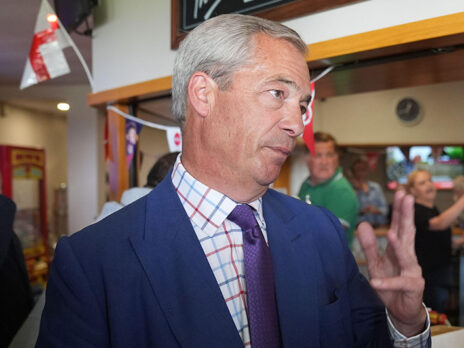
A very different politics – both structurally and culturally – will be needed for this fragmented age. Otherwise it will be the populist right that benefits from the chaos. If the progressive vote fragments while the regressive vote consolidates, Nigel Farage could yet become prime minister.

The two-class society of the postwar decades – with its culture of order, affluence, and the two-button choice of either BBC or ITV – was never going to survive the new world of kaleidoscopic identities, proliferating choice and growing economic insecurity. Even governments with large majorities struggled to deliver meaningful change, while the social glue of loyalty, habit and obligation has steadily dissolved. The financial crisis of 2008, austerity, Brexit, the Covid pandemic and the cost-of-living crisis have all accelerated these centrifugal political forces. From the SDP to the SNP, from the collapse of the ‘red wall’ and the ‘blue wall’, and now the rise of the Greens, Plaid Cymru, Muslim independents and others, it is clear that two-party politics will never return. Once, Labour and the Conservatives shared 98 per cent of the vote between them. Today, combined, they poll in the mid-thirties. Instead of two-party politics, we have entered the world of two-bloc politics.
On the regressive side, Reform and the Conservatives compete for supremacy. And this contest takes place under growing pressure from right-wing media and donors to ‘unite the right’ before the next election, in order to avoid repeats of the many seats in 2024 where the combined right-wing vote exceeded that of a victorious Labour candidate.
On the progressive side, three parties compete across England, and four in Scotland and Wales. Increasingly, voters move between parties within these blocs rather than across them. A young renter who moved to a large city and voted Labour in 2024 is unlikely to conclude that Reform offers the answers when the Greens present a more radical left-wing platform. Equally, an older and economically secure Liberal Democrat voter in the south-west who values the rules-based order and a more civil politics is unlikely to swing towards Reform.
As a result, talk of a “progressive majority” has grown louder than hopes for another Labour majority. Yet this progressive majority has existed for decades. Looking at every general election since 1979, the combined progressive vote has been larger than its regressive counterpart in all but 2015. Yet Labour has lost seven of those elections and won only four.
This is not an argument that voters will spontaneously organise themselves into a progressive bloc. It is an argument that they must be actively organised and shaped into a progressive majority capable of winning and sustaining a progressive consensus. The politics of the future will therefore be less about single-party consolidation and more about bloc formation: a campsite of like-minded parties rather than a single big tent.
Effective progressive cooperation would allow the progressive majority to be deployed far more efficiently, defeating the right in many seats if voters were mobilised behind the best-placed progressive candidate. Such cooperation could also bind progressive parties together in government, providing firmer ground for a sustained reform agenda – one that potentially lasts decades rather than a single term.
Crucially, mobilising progressive voters means winning a mandate for progressive change, rather than attempting to win over ever more Reform-curious voters while appeasing wealthy donors, media barons and tech moguls. In many ways this is the trap Labour fell into after its 2024 victory: it won office, but on a weak mandate that denies the promise of sweeping change. Next time will have to be different.
Ironically, Manchester both reveals the problem and the solution. The by-election loss was more than just a seat; it was the loss of Labour’s coercive stranglehold on the progressive majority. But Manchester is at the same time the birthplace of a new politics for Labour in the shape of its mayor, who wants both the progressive policies of small-‘p’ economic populism and the pluralism of a world of proportional representation and deep devolution. Little wonder that Polanski was said to be punching the air when he heard that Andy Burnham had been blocked from standing in the seat.
The biggest obstacle is the culture within parts of Labour’s leadership that would rather eliminate alternative views than share power with other progressive forces. This instinct has weakened somewhat in recent years, but still exerts a powerful grip on sections of the cabinet and party bureaucracy. Tribalism is not confined to Labour. Party leaderships often respond to the party system fragmenting by trying to tighten control. The Liberal Democrats and the Greens have both disciplined members who sought cooperation with other progressive forces. Every party maintains the fiction that it competes seriously in every seat and rejects any suggestion of pacts or deals.
At the same time, at the last election, Labour and the Liberal Democrats clearly reached informal understandings in many constituencies about which party would be the most viable progressive challenger. This smoke-and-mirrors approach ultimately weakens parties’ moral standing and leaves voters to work out tactical choices themselves. If no single party can win alone, and Labour has lost its monopoly of opposition to the right, the media will inevitably frame the campaign around coalitions and pacts. In some recent by-elections, Labour and the Greens have both insisted they were the only party capable of defeating Reform, leaving voters confronted with confusing tactical appeals.
What happens when progressive voters face three or four parties on the ballot paper with no clear indication of who is best placed to win?
If parties such as the Greens prioritise winning seats rather than maximising their national vote share – as their leadership has suggested – then members deserve greater honesty about that strategy. The same applies to Labour and the Liberal Democrats. Party members in unwinnable seats should be free to support the strongest progressive candidate. Indeed, parties that support proportional representation should begin to model the plural politics they claim to support.
Labour in particular faces a dual challenge: to reconnect with progressive voters and to accept the reality of a more plural political landscape. It must regain support from voters who have drifted leftwards while also learning to work alongside other progressive forces.
There are tentative signs of movement. Voices from Labour’s progressive wing have begun to re-emerge in internal debates, and support for proportional representation remains strong among members, unions and many MPs.
A deeper shift, however, will require more than electoral pragmatism. As the political theorist David Marquand argued, realignment must ultimately be a ‘realignment of the mind’. Solving the complex crises Britain faces – from inequality to climate change – will require the full spectrum of progressive perspectives.
In policy terms, there is already significant overlap: wealth taxes, new fiscal rules, public ownership of utilities, rent controls, media reform and electoral reform all command growing cross-party support within the progressive camp.
Labour voters themselves appear ready for this shift. Polling suggests a clear majority would be willing to vote tactically to defeat the right, and many voters say they would prefer a Labour–Liberal Democrat–Green coalition to a Conservative–Reform one.
The party system is already fragmented, and for good. The question now is whether progressive politics can adapt faster than the populist right. If it cannot, the right will capitalise on the confusion. But if progressives learn to cooperate, the fragmented landscape could yet produce a more democratic and plural politics.
In an age defined by complexity, the future will belong not to the biggest party but to the most effective coalition of ideas.
[Further reading: Ed Miliband is all-powerful]
Content from our partners



Related

Join the debate
Subscribe here to commentTrusting to tactical voting under FPTP will not suffice to block Reform and the current Conservative Party, which will unquestionably be its junior coalition partner. And some elements of the anti-Reform and anti-Conservative tactical voting movement in which the author places his hopes, may actually see advantages to a period of Reform-led government for their causes: notably the Scottish nationalists, but also perhaps some portions of the radical Left. Only a full-on move to proportional representation, which re-orders the party landscape to permit the emergence of a credible anti-Reform force on the Right, in the manner of the CDU/CSU’s refusal to countenance coalition with the AfD in Germany, will suffice.